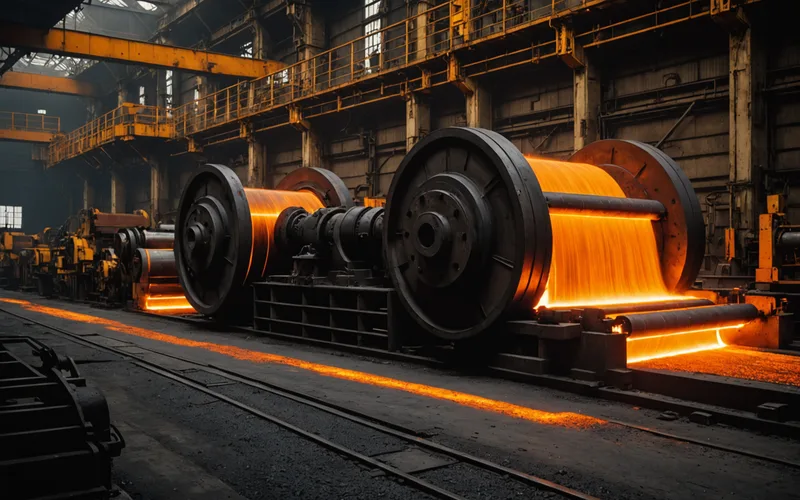
Steel rolling mills are one of the more technically demanding environments for production AI. Here is where the actual deployment value concentrates and where the challenges are hardest.
Rolling mills present a specific set of challenges for production monitoring systems that differ from other continuous manufacturing environments. The physical scale is larger: a finishing mill can be several hundred meters long, with multiple rolling stands, interstand cooling zones, and a runout table before the coiler. The data volume is correspondingly larger. The process speeds are higher than most other continuous manufacturing environments. And the consequences of a quality event are significant: a surface defect or internal void in a steel coil can result in the entire coil being downgraded or rejected, with rework costs that are multiples of the production cost of the material.
Against that backdrop, the deployment opportunities for production AI in rolling are substantial. The data infrastructure is generally better than in other manufacturing environments: rolling mills tend to have dense process historian installations from automation upgrades that accumulated over the past two decades. The quality problem is well-defined: surface condition, dimensional accuracy, and microstructural properties are the primary quality dimensions, and each has established measurement methods. The economic case for defect reduction is large enough that substantial instrumentation investment is justified.
Roll force and temperature as the primary signal channels
In hot rolling, the two process variable families that carry the most defect-predictive information are roll force profiles and temperature distribution. Roll force at each stand reflects the instantaneous deformation resistance of the material, which is a function of the material's temperature, composition, and prior deformation history. Variations in roll force relative to the expected profile for the target grade and dimensions indicate conditions that can produce surface or dimensional defects downstream.
Temperature distribution matters in hot rolling because the transformation behavior of the steel (and therefore its mechanical properties) depends on the temperature history through the finishing passes and the cooling rate on the runout table. Variations in the interstand temperature profile, which can result from inconsistent scale breaker performance, variations in interstand cooling, or entry temperature deviations, propagate through the finishing mill and affect both surface condition and microstructural uniformity.
The combination of roll force and temperature provides a richer signal than either channel alone. A roll force anomaly that occurs at a point where the temperature is within the expected range is a different condition from the same roll force anomaly with a temperature that's lower than expected: the lower temperature means higher deformation resistance, and the combination may indicate a local cold spot that originated in the reheat furnace or from inconsistent descaling. That context changes the attribution and the recommended intervention.
Where the model complexity actually lies
The complexity in building a reliable defect prediction model for a rolling mill is not primarily in the detection algorithm. It's in building a process model that correctly attributes the defect signal to the causal variable, accounting for the fact that a defect observed at the coiler can have originated several stands upstream, and that the causal condition has been transformed by several subsequent stands before the defect became observable.
The time-space transformation problem in rolling is more complex than in simpler continuous processes because the material velocity changes between stands (the material accelerates as it thins), the material length changes (a short slab becomes a long coil), and the thermal state changes continuously through the finishing mill. A model that doesn't account for these transformations will produce attribution results that are systematically offset in space and time from the true causal event.
Surface defect detection at mill speeds
Surface inspection in a rolling mill presents specific optical challenges. The material surface is hot, oxidized, and moving at speeds that can exceed 15 meters per second at the exit of a hot strip mill. Camera exposure times have to be short enough to avoid motion blur at line speed, which limits the light available for surface contrast. The surface temperature means that short-wave infrared imaging is often more effective than visible-spectrum for surface feature detection, but the camera and lighting investment is correspondingly larger.
The surface defect types that vision inspection needs to catch in rolling include scale-related defects (rolled-in scale, pitted scale, scale scars), mechanical defects (scratches, gouges from roll or guide contacts), thermal defects (cross-hatching from irregular cooling, thermal cracking in extreme cases), and metallurgical surface features from the alloy chemistry. Each defect type has different contrast characteristics and different lighting configurations that reveal it. Designing a surface inspection system for rolling requires choosing which defect types are primary for the specific product mix, because no single imaging configuration is optimal for all defect types simultaneously.
Edge cracking and its upstream signatures
Edge cracking in hot rolling is a specific defect mode with a characteristic process signature. It typically originates from edge cooling differentials in the finishing mill, where the strip edges cool faster than the center, reducing their ductility relative to the center at the rolling temperature. When the edge temperature falls below the ductile-to-brittle transition temperature for the steel chemistry, the deformation at the edge during rolling can initiate cracks rather than the plastic deformation the mill schedule assumes.
The upstream signature of edge cracking is measurable: edge temperature deviation from the center on the interstand pyrometers, variations in the edge masking effectiveness during interstand cooling, and roll force profiles that show asymmetric loading between the operator and drive sides. A monitoring system that tracks these channels and alerts when the combination approaches historically crack-associated conditions can give operators time to reduce rolling reductions, adjust edge cooling, or accept slightly lower speed to prevent the crack initiation before it commits to the strip.
Integration with Level 2 automation systems
Most modern rolling mills have Level 2 automation systems that manage the pass schedule, set points, and interstand adjustments. A production intelligence layer that sits above Level 2 can read Level 2's setpoints and actuals as inputs to the defect prediction model, and in some configurations can write back recommended setpoint adjustments when the model detects a developing quality risk. The integration architecture for this kind of advisory feedback varies significantly between mill control system vendors, and it's one of the areas where the deployment timeline estimate needs to be based on the specific automation platform in use, not on a generic integration assumption.
We're not saying that production AI replaces the Level 2 system or second-guesses its pass schedule calculations. The Level 2 system is optimizing for dimensional accuracy and rolling stability; the production intelligence layer is monitoring for quality risk signals in the combined process and surface data that the Level 2 system wasn't designed to interpret. The two layers have different jobs, and the interface between them needs to be designed carefully so that the advisory layer provides useful input without creating confusion about which system owns which decision.